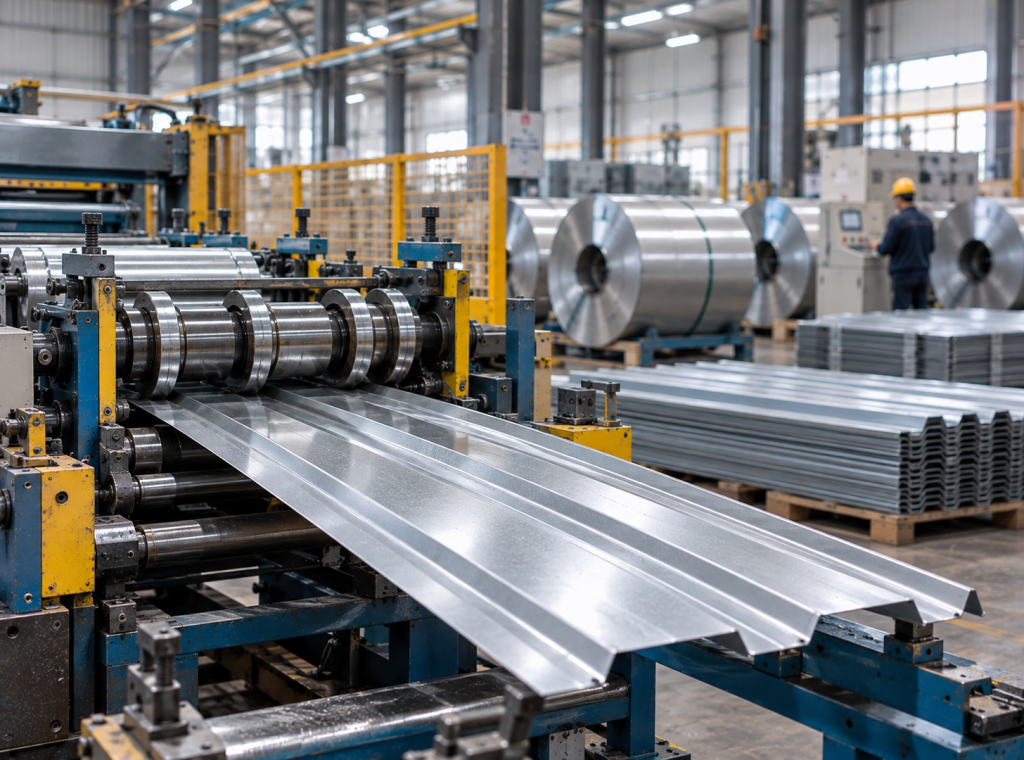
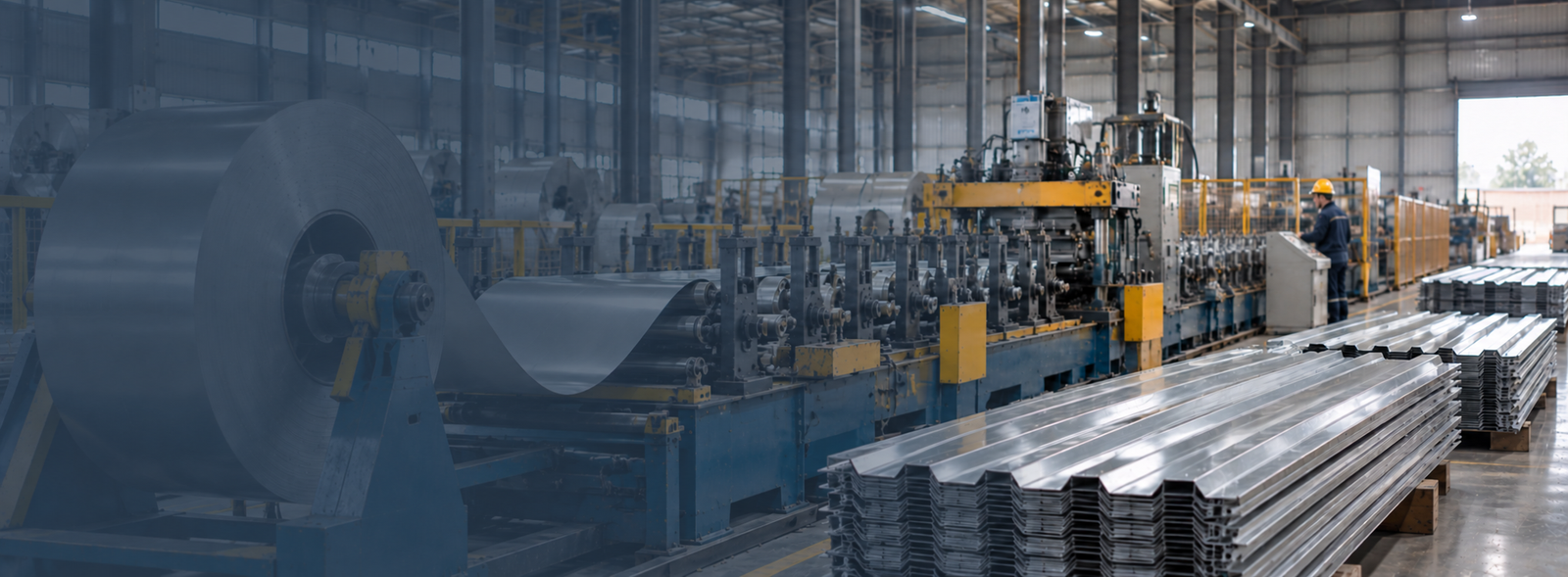
Roll forming subjects strip steel to repeated bending through multiple stands. Grade, strength, elongation, thickness tolerance, strip width, edge condition, camber, flatness, coating adhesion, and coil consistency can affect profile geometry, line stability, surface quality, and production yield.
PPGI and PPGL can support color-finished profiles, galvanized and galvalume coils can support metallic-coated components, and cold-rolled coils can suit uncoated parts requiring further finishing. The final coil specification should follow the profile drawing, roll design, forming line, finished component, and required surface.
Strip dimensions, formability, edge condition, coil build, coating performance, and the finished profile should be reviewed together.
Specifications should follow the component drawing, appearance standard, forming severity, joining method, finish, operating environment, and production equipment.
PPGI / PPGL / GI / GL / CR
According to Profile & Forming Requirements
According to Approved Profile Drawing
Calculated and Confirmed for the Profile
Slit Edge / Burr Direction as Required
According to Finished Component
Coil specification, slitting, surface protection, coil dimensions, inspection, and packing can be coordinated with the forming line and profile drawing.
The required strip width can be reviewed against the profile drawing, forming allowance, tooling, material thickness, and customer's confirmed calculation.
Slit width, tolerance, edge condition, burr direction, coil weight, and coil ID can be matched with confirmed equipment capability.
Metallic coating, paint system, color, gloss, coating adhesion, and protective film can be reviewed against repeated bending and surface requirements.
Coil orientation, inner and outer protection, labels, strip width, heat or batch references, pallet method, and container securing can be specified.
PPGI, PPGL, galvanized, galvalume, and cold-rolled coils can support different profiles. Grade, thickness, strip width, edge, coating, surface, and coil dimensions should match the profile and production line.
Strip width depends on the finished profile geometry, bend radii, material thickness, forming allowance, tooling, and line setup. The customer or roll-forming designer should confirm the developed width before production.
Burr height, burr direction, edge damage, camber, and slit-width variation can affect line tracking, profile dimensions, operator handling, joining, and finished-edge quality.
Suitability depends on grade, coating adhesion, bend severity, paint system, surface finish, tooling condition, lubrication, protective film, and appearance requirements. A trial may be needed for demanding profiles.
Coil ID, outer diameter, maximum coil weight, loading direction, and unwinding direction should be supplied so compatibility can be reviewed before quotation.
Please provide the profile drawing, material, grade, thickness, developed strip width, tolerance, edge requirement, coating or paint, color, protective film, coil ID, coil weight, quantity, destination, and packing method.
Arabic
English
French
Portuguese
Spanish